

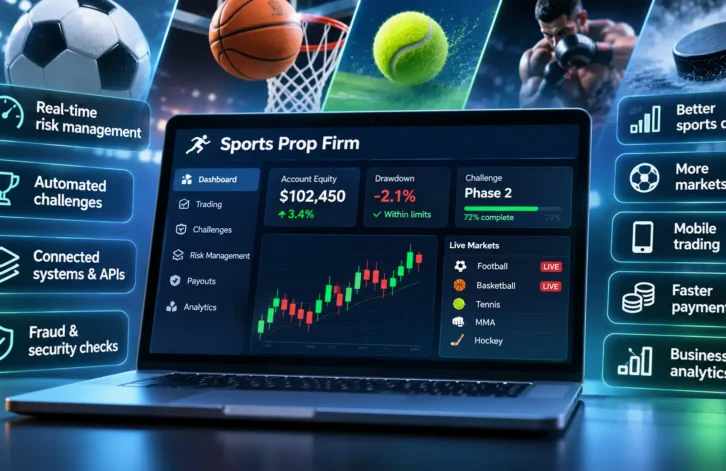
Running a sports prop firm involves several systems working together. Account setup, challenge rules, live sports data, risk checks, payments, and trader dashboards can all be managed through connected software, reducing the need for manual work.
For traders, this can mean faster updates, easier account management, more markets, and clearer information about your performance. For firms, these tools make it easier to manage more accounts while keeping track of risk and daily operations.
Keep reading to see how these technologies are changing sports prop firms and what they can mean for traders.
1) Real-Time Risk Management
Real-time risk engines can monitor account equity, drawdown, position sizes, exposure, and challenge rules as trading activity happens. Instead of checking results at the end of the day, the system can evaluate each trade against the firm’s rules and trigger an alert or action when a limit is reached.
Some modern prop platforms use server-side rule enforcement for limits such as daily drawdown, maximum loss, profit targets, consistency requirements, and position-size restrictions.
2) Automated Challenge Management
Challenge engines now allow firms to create different evaluation structures without building each one from scratch. A platform can define the account size, profit target, maximum drawdown, minimum trading days, time limits, and other rules before a challenge goes live.
Some systems support one-step, two-step, three-step, and instant-funding models. The same system can track your progress through each phase and automatically update your status when you meet a requirement or breach a rule.
3) Better Sports Data
Sports prop firms need several types of information, including fixtures, scores, odds, player statistics, live events, and historical data. Sports data APIs can bring these feeds into one platform so you can see market information.
Live data is especially important for in-play markets. A sports data API can provide event updates, match status, statistics, and market prices through software connections that update as games progress.
4) More Trading Markets
Operators can connect multiple sports and leagues to the same account and risk infrastructure. That can include football, basketball, baseball, soccer, MMA, hockey, and other sports. A platform may also support straight selections and parlays.
5) Connected Trading Systems
A sports prop firm can have several systems. The trading interface, challenge engine, CRM, payment provider, risk engine, and customer database all need to exchange information accurately.
Modern prop technology can connect these components through APIs and integrations. Some platforms support connections with trading terminals, payment processors, KYC providers, CRM systems, and other services through a single technology stack.
Using technology in sports prop trading, such as that offered by Sports Prop Tech, allows firms to connect these systems in one place. You can then move from buying a challenge to trading, checking your account, and requesting a payout without having to deal with several disconnected platforms.
6) Automated Fraud and Security Checks
Technology can also help firms identify activity that may require additional review. Systems can examine account connections, login activity, device information, trading patterns, and other data points to identify potential abuse.
Fraud tools can be connected to KYC and AML systems during the onboarding process. Some prop firm platforms now combine identity verification, agreement management, account creation, risk monitoring, and fraud detection in the same workflow.
7) Faster Payments and Payouts
Sports prop firms can connect their platforms with payment providers to process challenge fees, refunds, and trader payouts without relying on as much manual work.
You can also get clearer updates on your payment status. Once you meet the firm’s payout requirements, an automated system can check your eligibility and send the request for processing.
8) More Useful Trader Dashboards
Modern platforms can show your equity curve, profit and loss, drawdown, challenge phase, trading activity, and other performance statistics in one place. Some systems also include real-time phase tracking, live charts, leaderboards, payout requests, and performance metrics.
9) Mobile Trading Access
A mobile-responsive system can adjust the dashboard, charts, account statistics, and market information to smaller screens. This is especially useful when you only need to check your account status or review a position while away from your main computer.
10) Better Business Analytics
A firm can track active accounts, challenge purchases, pass rates, rule breaches, payouts, trader activity, and other metrics from a central dashboard.
These figures can help operators identify patterns in their business. A high breach rate on one challenge, for example, may lead the firm to review its rules or account structure. Strong demand for a particular sport could also influence which markets the platform supports.
The Future of Sports Prop Firms
Technology is making sports prop firms easier to run and easier to use. Faster data, automated challenge management, real-time risk checks, better payment systems, and detailed dashboards can improve the experience for both traders and operators.
For traders, these tools can give quicker access to market information and a clearer view of their account. Firms can also use connected systems to manage more users while keeping their operations organized.
As the industry grows, expect more automation, better data, mobile tools, and AI-supported features. Reliable systems, clear rules, strong security, and a simple platform will still matter when you choose a sports prop firm.