

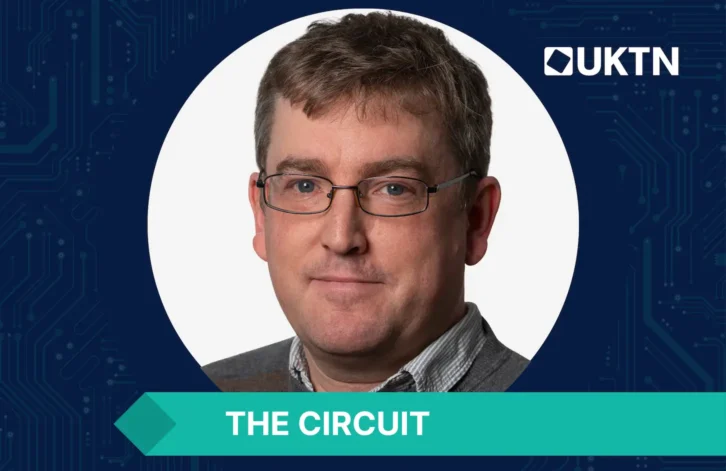
Welcome to The Circuit series. Meet our next interviewee:
Fintech is often held up as the gold standard of a UK tech success story. One that took a sector that the country was already a global leader in, finance, and spawned an enormously valuable sister sector that has gone on to represent a huge percentage of the world’s third largest tech industry.
When it was still a novel concept, some saw fintech as a replacement for traditional finance, but today these parallel industries are deeply integrated with each other, particularly as innovations in Open Banking have created opportunities for major financial infrastructure to be supported by newer technologies.
The union of fintech and finance is well exemplified by Payit, an Open Banking payment service created by NatWest.
In this exclusive Circuit interview with UKTN, James Hodgson, chief executive of Payit as well as Tyl, another tech product made by the global bank, discusses how finance has changed over the decades since he entered the industry, how tech has fused with the ancient sector and what innovations can be expected on the horizon.
How has the banking and finance sector changed in your career?
There’s no doubt that the sector has changed, the banking and finance landscape in 2026 is unrecognisable compared to a decade ago.
The rise of technology is evident yet undeniable, and we have entered the Agentic AI era. AI use is no longer centred around basic fraud detection and clunky chat bots, moving to much more advanced capabilities.
Beyond this, it is easy to forget that we used to have to go to a physical branch (still remaining a vital touchpoint) or access our banks on a web browser, but it is now all at our fingertips – whether that be the mobile app or embedded experiences enabled by APIs.
Technology has also enabled customer experience to greatly improve, with speed of service increasing due to new developments – ultimately, that’s what we are aiming to do.
Within these years of being in the industry, Open Banking itself has evolved, it had not even emerged when I first started my career – but now, here we are with a product that is changing the future of banking.
Where can Open Banking go from here? What progress could we see as it develops?
It is an exciting time for Open Banking, with many updates planned and incoming. We are pleased with the industry response and pick up to Open Banking over the years with businesses truly seeing the security and efficiencies that come with the product.
We have actually seen a recent shift, with it no longer being just early adopters and many businesses now actively exploring it and taking it seriously, the most obvious being Amazon’s launch of Pay by Bank earlier this year.
The conversation has shifted from ‘what is Open Banking’ and industry awareness being much greater.
We have got some launches this year. For instance, products that will allow consensual access to greater customer data, allowing for businesses to improve their processes, enabling a faster and more accurate risk assessment or onboarding process, and ultimately ensuring vulnerable customers get the right financial support.
But this is not where it ends, with new products designed to elevate the experience for both our direct clients and the end customer.
The tech and infrastructure that we have access to, as a trusted bank, means that we are truly able to improve our services continually and in line with the changing market.
How separate (or intertwined) do you view traditional finance and fintech?
Open Banking is arguably the glue that is keeping these things together, specifically relating to the role of API.
This tech allows data to flow securely between financial institutions and third-party providers and is at the core of Open Banking – and can link fintech directly to traditional banks.
We at Payit by NatWest are distinctive in our offering of being rooted in a trusted bank. NatWest provides the resilience and long-term stability, that is becoming crucial as the market matures.
While we run a technology estate and operating model that delivers customer and user experiences more akin to a fintech. So, we ourselves are a fully integrated traditional bank utilising fintech solutions – and in today’s world it is difficult to separate the two.
What excites you most about the future of your sector?
The sheer pace of our progress in such a short window is incredibly motivating. Given how far we have come already, the possibility for what we can achieve in the next chapter is truly exciting.
Open Banking has not met its potential yet, especially from a consumer’s point of view, given the increased security benefits and the lack of need to input your card number.
The increased and ongoing focus from UK regulators will continue to catalyse the market.
Businesses are already relying on the benefits of the product, and consumer adoption is improving across the board. I’m looking forward to the growth potential.
Are there any challenges in your sector that are not discussed enough?
This sector benefits from a high degree of regulatory and industry focus so I don’t think the challenge is lack of discussion.
In some cases, that discussion does need to be focused into more decisive action which is why we now wait with anticipation for the upcoming launch of commercial VRP.
There has been a lot of discussion on the need for consumer branding and consumer protection, often citing card schemes as the example.
I would like to see as much focus on some of the core product capability, such as certainty of fate and improving the API performance with some of the ASPSPs (Account Servicing Payment Service Providers).