Register for Free
Bookmark your favorite posts, get daily updates, and enjoy an ad-reduced experience.
Already have an account? Log in
Bookmark your favorite posts, get daily updates, and enjoy an ad-reduced experience.
Already have an account? Log in

March 2024
Wales is home to numerous tech clusters that foster collaboration, networking, and knowledge sharing among startups, investors, and established businesses.
There’s also an array of great landing places for early-stage and spinout businesses across Wales, including Tramshed Tech, a community of tech startup and scaleup businesses in Cardiff and Newport, Sbarc in Cardiff and M-Sparc in North Wales both offering a hub for innovation, startups and spinouts.
With world-leading expertise in sectors like fintech, compound semiconductors, medtech and cybersecurity, Wales benefits from world-class universities and spinouts that are actively involved in research and development programmes. There’s no doubt that this strengthens the clusters that we have here, while collaboration between industry and academia plays an important role in developing the skills and talent required for the tech sector to grow.
For example, programmes offered by the Alacrity Foundation are helping to support the next generation of entrepreneurs. Their alumni include Ieuan Leigh, Katie Turnbull, Thomas Elliott and Gareth Williams, the founding team of Valident who completed the Alacrity Foundation programme in 2021. The Newport-based tech venture is helping the professional services sector to keep up with increasing regulatory compliance. With two investment equity rounds totalling £440,000 from the Development Bank and co-investors Wesley Clover, Validient is the only Welsh tech company to get a place on the LawtechUK Programme, supporting UK- wide expansion plans.
There’s an incredibly supportive ecosystem here in Wales that has matured significantly over the last five years meaning that there’s always help available for those starting, growing and scaling a business. Indeed, it’s the ecosystem that is really driving the growth of the tech sector and the wider economy in Wales.
The tech ecosystem in Wales is so supportive and collaborative. The investment funding from the Development Bank and Wesley Clover will enable us to further develop our product and invest in our sales resource.
Ieuan Leigh, chief executive, Validient.

Duncan Gray,
technology venture investments director, Development Bank of Wales.


Wales, with its rich manufacturing heritage, fosters a strong drive for innovation. However, startups and scaleup technology businesses face both opportunities and challenges in the region. The Welsh government offers various support mechanisms and grants to aid business growth, complemented by wider support from Innovate UK.
Talent acquisition remains a key challenge, with skilled individuals often leaving the area. This is where prior planning should play a role – as well as engaging with educational institutions in the region to scope out what skill sets are available and if it’s feasible to grow there.
Dr Alvin Orbaek White, founder of TrimTabs, has been fortunate to be able to “tap into the genius cluster that sits around the South Wales area”.
“Relevant skills are well represented and strong in the area, so if you’re deep tech or manufacturing like I am, there’s a good graduate base of engineers and lots of professional engineers in the area,” he said.
More can certainly be done to retain this talent in the region and drive further innovation. “A lot of students who become skilled in Welsh universities tend to go home as connectivity is difficult in the region,” White continued. “It’s very hard in some locations; there are some industrial sites which are very hard to reach if you don’t have a car and the bus and trains aren’t always reliable.”
Incubators also play a crucial role in supporting startup companies. They can provide a range of resources and services that help entrepreneurs develop and grow their businesses. However, White’s experience reveals a scarcity of such facilities in Wales, prompting him to consider relocating to Ireland because he can “easily find the space” there.
“To do deep tech, green tech or manufacturing work, you need plenty of floor space, not just desks,” he explained. “I have found these sites in the rest of the UK and Ireland, but not in Wales.”
Networking is essential for entrepreneurs, and this is where advisers play an important role as they can bring together everyone you will need at different stages of company growth.
While the government provides several grants to support growth, there is a lower appetite for risk among investors in Wales (possibly across the UK), hindering the growth of companies that need additional investment to scale.
For White’s business that makes nanotubes, having more investors with the vision to see the long-term benefits rather than a focus on the short-term bottom line makes all the difference.
He explained: “At TrimTabs we make carbon nanotubes that go into batteries. Batteries are already on the market, but we’re also looking at a completely new product that may not bear fruit for at least 20 years, but when it does it will change our relationship with energy supply and demand.”
To foster innovation in the region, risk-taking, providing space for scaling technology, and enhancing networking opportunities are crucial. Additional support through accelerators and incubators, inward investment, and improved connectivity will contribute significantly to transforming Wales into a thriving deep tech and green tech hub.
Dr Alvin Orbaek White, an associate professor and former Sêr Cymru II Fellow at Swansea University, is the founder and chief executive of TrimTabs.
Swansea-based TrimTabs strives to drive innovation, create positive change, and promote sustainability with cutting-edge circular economy technology to make high-quality carbon nanotubes. TrimTabs was the South West and Wales finalist in the national KPMG UK Tech Innovator competition in 2023.
Tom Fox is emerging giants lead for South West and Wales region at KPMG in the UK. In KPMG’s emerging giants team, Tom engages with the early-stage tech community across the South of England and Wales to help them succeed by introducing them to KPMG expertise to support them in their growth. Tom is also part of KPMG’s university partnerships team and works with partner universities to deliver deep and commercially useful insights to businesses, amplifying growth, innovation, and productivity in regional economies, while supporting the universities in the commercialisation of their research and the career readiness of their students.

Tom Fox,
emerging giants lead for South West and Wales region, KPMG in the UK.


Tom Fox,
emerging giants lead for South
West and Wales region, KPMG in the UK.
The Welsh region is positioned to support ever-evolving sectors such as medical devices, fintech and clean tech through the courses that local universities specialise in. There is also a deep appreciation for the region’s manufacturing roots which can be seen through continuous innovation in the agritech space.
Supporting the growth and development of small to medium sized businesses is a big part of the Welsh government’s plans for the future of the region, as well as the Development Bank of Wales which is there to provide much-needed capital for growing businesses. Another key factor is the active encouragement of collaboration between businesses and educational facilities to ensure that the right talent and skills are being developed to support the growing tech ecosystem.
UKTN commissioned Censuswide to survey more than 100 senior managers at technology companies in Wales to explore how the tech community currently views the region’s tech sector and represent the experiences of those running tech companies across Wales.
The 132 survey respondents represented a natural spread across gender, age and company subsector. The majority of respondents (66%) worked at tech companies with at least 100 employees, so the following views are more accurately taken as those of established tech companies rather than early-stage startups.
South East Wales was the most common HQ location among respondents (39%), followed by South West Wales (32%). A significant proportion (20%) worked for tech companies in Mid Wales but the views of those in North Wales are less represented in the overall trends below, with only 8% of respondents working there.
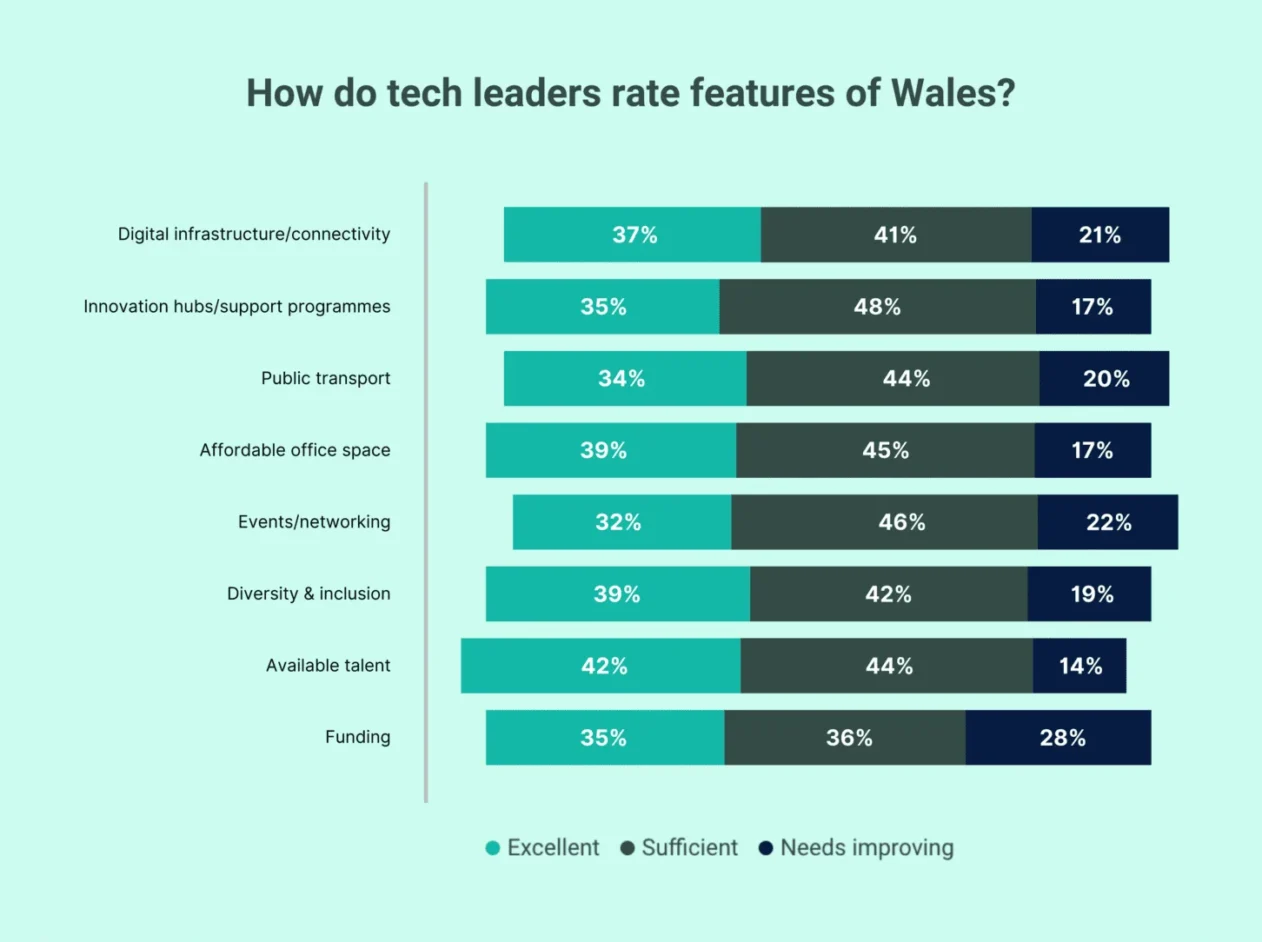
Tech leaders across Wales generally rate the business infrastructure and support fairly well – with all features of the business environment being rated ‘excellent’ by at least a third of respondents.
Funding receives one of the lowest evaluations, which is consistent with stakeholders’ views shared in research interviews that startups often struggle to raise growth-stage funding. When the survey results are split by region, a slightly different picture of infrastructure and support emerges: South West Wales rates digital connectivity, affordable office space and available talent significantly higher than respondents generally, and South East Wales rates networking and funding lower, with more respondents saying these ‘need improving’ than are excellent. The biggest regional discrepancy is around digital connectivity, with Mid Wales – a predominantly rural region without major cities like Cardiff and Swansea – reporting lower levels of satisfaction.
Though the North Wales respondents are too small a sample size to be confident that the survey results are representative of views in that region, the insights do show trends that tech workers in North Wales rate digital connectivity much lower than others across Wales (more than a third said it needs improvement), and believe diversity and inclusion is better than others elsewhere (64% rated it excellent).

Mark John,
co-founder at Tramshed Tech.
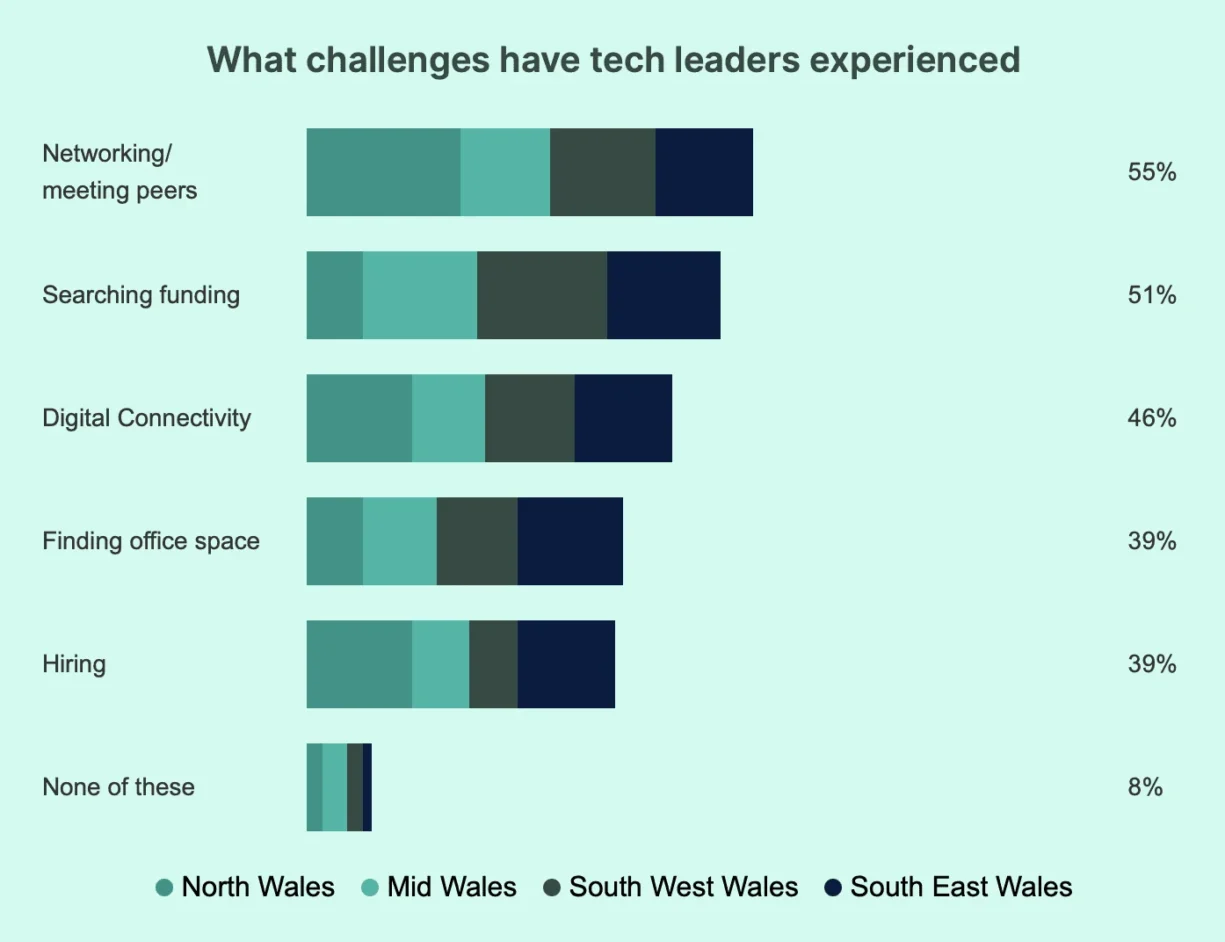
North Wales Mid Wales South West Wales South East Wales
The chart shows both the relative proportion of people in each region who have experienced each business challenge (normalised by the number of survey respondents in that region), and how common each challenge is across all survey respondents.
The results show that networking is the most common business challenge, and is felt more strongly by tech workers in North Wales than elsewhere. Securing funding is the most common business challenge in South East Wales, South West Wales and Mid Wales, while hiring is significantly more of a challenge in North Wales and South East Wales than elsewhere.

Louise Harris,
co-founder and CEO at Tramshed Tech.
Access to the right investment at the right time is an ongoing challenge for Welsh startups. Wales only receives 2.5% of the UK’s equity investment deals despite being home to 3.5% of its high-growth companies. Inward investment is a key catalyst for growth in Wales.
Investment into digital connectivity comes out top as the factor that would drive growth for Wales’ tech sector, and we can see that is felt similarly strongly across all regions.
But the next highest driver of growth – more careers and skills initiatives – is seen as more important in Mid and North Wales than in the South, whereas attracting global tech businesses is a higher priority in both South West and South East Wales.
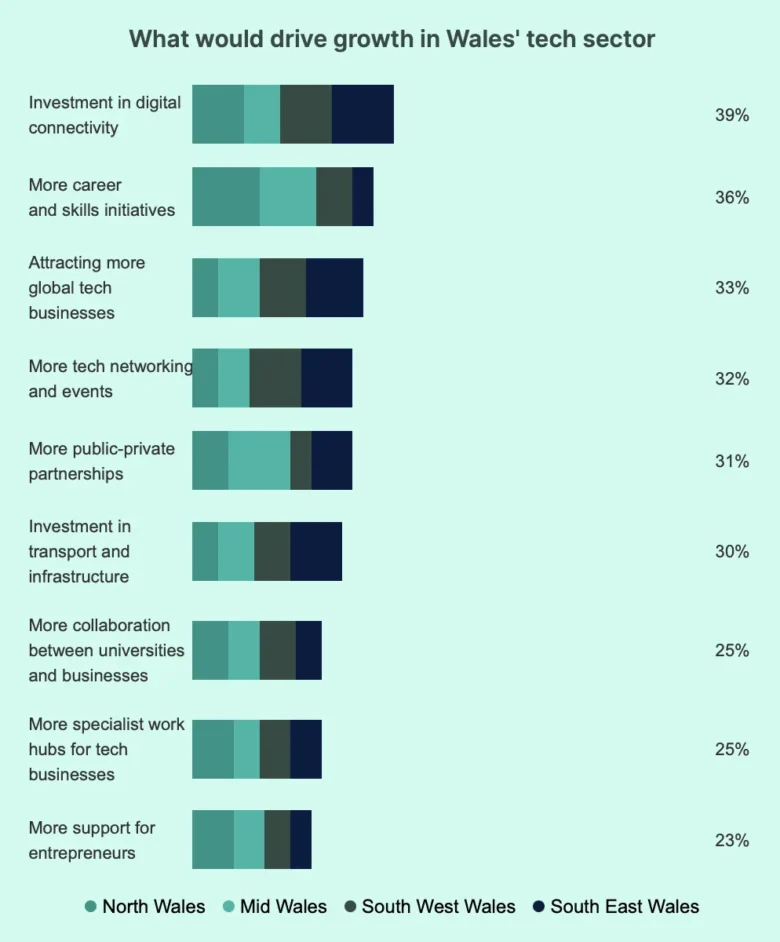
North Wales Mid Wales South West Wales South East Wales
Creative Wales reports an annual turnover of more than £2.2bn and over 56,000 people employed in Wales’ creative industries. With strong Welsh government backing and around 500 new enterprises entering the market each year, creative industries are one of Wales’ fastest-growing sectors.
With Cardiff at its core, South Wales has become the nation’s creative hub, making up 80% of all creative industries. Well above the UK average, 15% of all enterprises in Cardiff are within creative industries, so it’s not surprising that the city has been named the third largest production centre in the UK outside of London and Manchester.
Despite Wales’ track record in producing world-class shows including Doctor Who, Sex Education and His Dark Materials, the nation is yet to receive the international recognition it deserves as a major audiovisual production centre and creative cluster.
Prof Sara Pepper OBE, deputy director of Media Cymru, said: “Media Cymru is leading the charge to position the Cardiff Capital Region and Wales as a leading centre for innovation in media production.
“As part of our international engagement, we’ve made connections in the US, Norway, Germany and Japan to build collaborations and engage in research and knowledge exchange. This year, we’ll be announcing our latest ‘Innovator in Residence’ opportunity featuring international partners, which is a great opportunity to cement links with media organisations internationally and learn from the very best in the business.”
In addition to English language productions in Wales, the international demand for compelling Welsh-language thrillers such as The Light in The Hall (Y Golau), has in recent years significantly contributed to the growth of global sales for UK TV shows, reaching a new milestone of £1.5bn according to Pact, who represent independent media production and distribution in the UK.
There is no denying the potential that technology unlocks in creative industries, particularly the impact that virtual reality, augmented reality, and artificial intelligence can have on TV production, gaming and animation when it comes to fresh ways of creating content, distributing content and reaching new audiences.
A Welsh business being recognised globally for its work in TV, film and gaming is Cardiff-based indie production company turned game developer Good Gate Media, which leverages immersive technologies in ways that will extend the lifetime value of characters and increase revenue streams.
With films such as ‘Don’t Knock Twice’ (feature film turned game), ‘The Machine’ (commissioned into a $9m TV pilot by NBC Universal) and ‘The Man in My Basement’ (staring Corey Hawkins and Willem Dafoe set for release on Andscape, the Black-led content studio from Disney and ESPN), the potential for creative production in Wales is vast. In 2024 alone, supported by Creative Wales, Media Cymru and Ffilm Cymru, Good Gate Media has already been responsible for securing and deploying eight figures of spend across film, games and TV production.
John Giwa-Amu, CEO at Good Gate Media said: “Good Gate has grown from humble beginnings over the last four years and we’re proud to see 2024 bringing in large-scale, world-class productions across film, TV and games through our Cardiff-based company.”
Gaming is an emerging subsector in Wales which draws upon a pipeline of talent from world-class universities across the country. With strong hubs in South East and North East Wales, brands like Wales Interactive and Tiny Rebel Games make their way to screens across the world.
The combination of government support, a pipeline of talent and innovative businesses operating in the region means that Wales is primed for success in creative industries. New initiatives such as the Convergent Content Programme delivered by Tramshed Tech in partnership with M-SParc, Cardiff University and Barclays Eagle Labs, funded by the UK government, are designed to foster innovation and forge powerful connections between Wales’ vibrant tech, media and creative sectors.
Whisper has established itself as one of the UK’s leading production companies. In addition to recently winning a Bafta for its coverage of The Women’s EURO 2022 for BBC, its credits also include Formula One for Channel 4, Today at The Test for BBC, Women’s Super League for BBC and the 2020 Toyoko Paralympics for Channel 4.
In 2023, it was announced that Channel 4’s coverage of the Paris 2024 Paralympic Games will be produced by Whisper at Tramshed Tech in Cardiff with the on-screen team in Paris, making it the biggest sports production to ever be based in Wales.
New state-of-the-art technical facilities are currently under development and include production galleries and edit suites. It is hoped that this will leave a legacy and encourage other events and programmes to come to the new hub.
Whispers team of 25 will quickly grow to 200, expanding their presence and boosting the TV production industry in the region significantly. As part of these growth plans, Whisper has launched ‘Whisper Academy’, designed to train and retain the next generation of production talent in Wales.
Louise Harris,
CEO and co-founder at Tramshed Tech.

True False Don't know
True False Don't know
True False Don't know
True False Don't know
True False Don't know
True False Don't know
True False Don't know
True False Don't know
The cyber sector is largely concentrated in South East Wales, with a critical mass of large multinationals and SMEs, alongside two universities with courses accredited by the National Cyber Security Centre. Though the sector is fairly small, it represents 3% of all cybersecurity companies in the UK and employs 4% of the UK’s cyber workforce.
The potential of the region’s cyber sector has been recognised by the Welsh government and the Cardiff Capital Region, which invested in the Cyber Innovation Hub that launched in 2023 with the aim to grow and transform the region into a leading cyber cluster by 2030. In its first year, Cyber Innovation Hub has set up training courses and bootcamps, a venture builder programme for new ideas and cyber testbeds for local companies to build digital twins to test their cyber resilience.
2023 also saw the publication of the Welsh government’s Cyber Action Plan, which provides the policy foundations for growing the sector and making the most of the potential benefits for the Welsh economy and society.
Airbus Cyber Innovation – the company’s cyber research facility in Newport – is a key player in the cyber cluster, alongside Thales, which grew its presence in Ebbw Vale from a single project in 2019 (the £20m National Data Exploitation Centre) to a cyber campus which includes cyber testing facilities, autonomous vehicle workshops and an immersive customer experience centre. Together, the North and South Wales cybersecurity clusters have more than 2,000 members.
Cardiff-headquartered PureCyber employs around 30 cyber experts, having grown significantly since its launch in 2011 as a ‘one-man-band’.
Between 2018 and 2022 the cyber consultancy and tech company quadrupled in size and in 2022 it moved into new headquarters in Cardiff’s new business centre at One Central Square, rebranding from its original name ‘Wolfberry’ to reflect its next chapter of development.
Announcing the rebrand and ‘next chapter’, founder Damon Rand said: “We’re founded and headquartered in Wales and incredibly proud of our Welsh roots, but we’ve also got a strong global footprint and we are excited to move forward with our talented team at the forefront of change and innovation as PureCyber.”
PureCyber is repeatedly named as a leading cyber company by stakeholders across the UK – including many interviewed for this report – and has won several awards. The company contributes to national cyber initiatives, including the recently announced Smart Partnership project with the Welsh government and Swansea University to address the existing barriers hindering small businesses from accessing robust cybersecurity solutions.
Wales has a thriving cybersecurity sector which is growing an international reputation. In the Welsh Government International Strategy, Wales is recognised as world class in cybersecurity. The Cardiff Capital Region (CCR) too has identified cybersecurity as a key sector of interest in its investment framework and Skills Partnership – with much of Wales’ cybersecurity activity clustering in southeast Wales.
The Cardiff Capital Region is home to several large companies whose core activity is focused on products, services, or innovation in cybersecurity. Thales and Airbus have laid significant roots in cybersecurity innovation in the region and are heavily engaged with public sector activities, working in partnership with Welsh government, Cardiff University and University of South Wales.
This sits alongside large business footprints at BAE Systems, BT, General Dynamics, Jacobs, CGI and PwC – the latter two having built cybersecurity hubs in Bridgend and Cardiff respectively aiming to develop a platform for the future through the recruitment of over 200 people in cyber roles between them. In 2021, PwC launched a new hands-on cybersecurity MSc programme with Cardiff University to help them achieve PwC’s vision for a cyber skills and capability hub in Cardiff.

Professor Pete Burnap,
director at Cyber Innovation Hub.

To provide the best experiences, we and our partners use technologies like cookies to store and/or access device information. Consenting to these technologies will allow us and our partners to process personal data such as browsing behavior or unique IDs on this site and show (non-) personalized ads. Not consenting or withdrawing consent, may adversely affect certain features and functions.
Click below to consent to the above or make granular choices. Your choices will be applied to this site only. You can change your settings at any time, including withdrawing your consent, by using the toggles on the Cookie Policy, or by clicking on the manage consent button at the bottom of the screen.
