

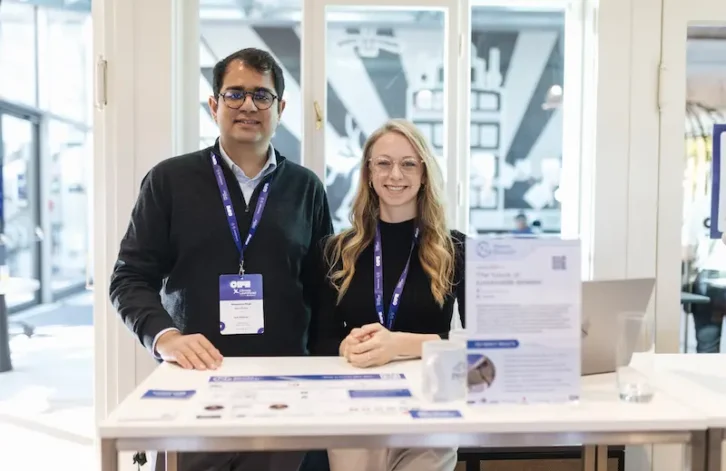
Cambridge-based startup Neela Biotech has raised £2.1m in pre-seed funding to scale its AI-driven technology that converts food, agricultural and forestry waste into sustainable aviation fuel (SAF).
The funding will support the company’s transition from laboratory development to pilot-scale trials at an existing biogas plant over the next two years.
The round was led by climate tech investor Elbow Beach, which contributed £1.5m, with participation from Ascension, Cambridge Enterprise, Ventures Together and strategic angel investors.
Neela Biotech is developing a process that uses AI-guided microbial technology to convert organic waste into fatty acids, a key ingredient in the production of sustainable aviation fuel.
The company hopes its approach will address one of the aviation industry’s biggest decarbonisation challenges: producing sufficient quantities of sustainable fuel at a price competitive with conventional jet fuel.
Using AI to tackle aviation’s fuel challenge
Most sustainable aviation fuel is currently produced using hydroprocessed esters and fatty acids (HEFA), a process that converts waste cooking oils and other fats into fuel.
While HEFA accounts for approximately 95% of current SAF production, the availability of suitable waste oils and fats limits how far the technology can scale.
Neela’s technology aims to overcome this constraint by converting more abundant waste materials, including food waste, agricultural residues and forestry byproducts, into feedstocks compatible with existing HEFA production.
The startup’s Controlled Microbial Upcycling process combines advances in synthetic biology with AI to optimise the conversion of organic waste into fatty acids.
Rather than requiring entirely new production facilities, Neela plans to integrate its technology into existing anaerobic digestion infrastructure, including biogas plants operating across Europe.
The company believes this approach could significantly reduce the capital investment needed to scale production while creating additional revenue opportunities for biogas plant operators.
Neela also claims its lower-energy microbial process could provide a route to producing sustainable aviation fuel at cost parity with conventional jet fuel as production scales.
Funding to support pilot-scale production
The £2.1m investment will enable Neela to advance its technology towards commercial deployment, with a pilot-scale trial planned over the next two years.
The company is also participating in the International Airlines Group (IAG) innovation programme and has secured grant funding from Innovate UK and the Henry Royce Institute.
Jonathan Pollock, CEO of Elbow Beach, said the company’s ability to use existing infrastructure was a key factor behind the investment.
“Aviation’s fuel bill is only going one way, and the industry urgently needs alternatives that can scale commercially,” said Pollock.
“Too much SAF technology solves for cleaner fuel without solving for cheaper or more available fuel, largely because it still depends on limited feedstocks like waste cooking oil.”
He added that Neela’s approach avoids some of the capital costs associated with other SAF technologies while offering the potential for commercial deployment.
Deepanshu Singh, CEO and co-founder of Neela Biotech, said the limited availability of waste oils presented a significant barrier to scaling sustainable aviation fuel production.
“Most SAF today is made from waste oils and fats through HEFA. But the world burns 300 million tons of jet fuel every year, and there is simply nowhere near enough waste oil and fat to meet this demand,” Singh said.
“Our Controlled Microbial Upcycling process leverages recent advances in AI-driven synthetic biology to convert diverse waste streams like food and agriculture waste into HEFA-compatible feedstocks.”
Singh added that integrating the technology with existing biogas plants could reduce capital requirements, accelerate deployment and enable more localised production of sustainable aviation fuel.
“The £2.1 million funding round, led by Elbow Beach, will help us scale towards our pilot and move us closer to making locally produced SAF cost competitive with fossil fuel.”