


Executives often talk confidently about AI, often as if the direction of travel is already settled.
But away from the soundbites, many organisations are still facing challenges lining up ambition with reality, unsure what success looks like.
That tension sits at the heart of how Leila Romane, managing director of SAP UK & Ireland, describes the current moment. AI may be firmly on the agenda, she suggests, but the harder work is deciding where it delivers value.
“AI is currently a very hot topic,” she says. “The question that we pose ourselves and back to customers is: where would you like to benefit from it? Where are you seeing the most growth? How do you make yourself more resilient as a UK business?”
Those questions are becoming unavoidable. SAP’s latest research with Oxford Economics shows UK firms are spending real money on artificial intelligence, but often without a clear plan for how it all fits together.
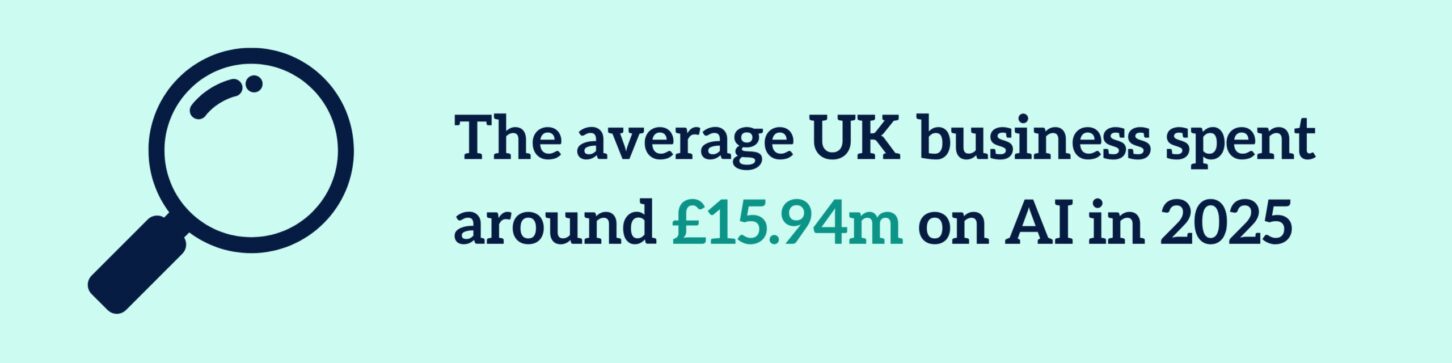
The average UK business spent around £15.94 million on AI in 2025, according to the study, and firms expect to increase that outlay by around 40% over the next two years.
Executives see tangible benefits: average return on investment today is about 17%, with forecasts suggesting that figure could almost double by 2027.
Yet the same research points to a disconnect between spend and strategy.
Just 7% of businesses describe their AI investment as part of a long-term, enterprise-wide plan, while nearly half characterise their efforts as piecemeal. Around 70% say they are unsure whether AI is delivering its full potential.
Romane sees that gap play out regularly in conversations with customers. “What we’re currently seeing is, the percentage is quite high, but it’s low,” she says. “What I mean by that is, all companies are working in that space, but the holistic adoption across an organisation is low.”
That uneven progress helps explain why AI anxiety has not disappeared, particularly around jobs, though Romane is unconvinced that AI will hollow out the workforce.
“I’m not sure I would agree that AI is taking over jobs,” she says. “I think it’s more about the need to embrace it, how it’s making people and companies more efficient and able to focus on their business priorities such as business growth and differentiation.”
According to Romane, AI is redefining how work should look – especially for those at the start of their careers. “Young people entering the workforce have great brain power,” she explains.
“We have moved away from assigning junior staff routine tasks such as notetaking and administrative work. There is a shared understanding that we can use new starters in a much more efficient and valued way.”
Her concern is not with new tools, but with the pace organisations adapt their habits around them. One consequence of that lag is that employees often move faster than their employers.
SAP’s research suggests many businesses are already seeing staff experiment with AI tools outside official systems. That creates its own risks, particularly when governance and training have not kept pace.
Romane is clear-eyed about the challenge. “As part of upskilling and reskilling, businesses are having to consider ethical AI use carefully and give clear guidance on what tools are appropriate,” she says.
“With so many open AI tools available, security becomes a key concern once they are brought into an organisation.”
Where organisations do make progress, she says, it tends to be because they treat AI as something that cuts across the business rather than a bolt-on.
That often means embedding intelligence into end-to-end processes – from customer engagement to decision-making – rather than isolating it in pilots.
For Romane, the way forward is not mysterious, just demanding. “Upskilling and reskilling plays a major role, so too does the data element,” she says.
“The key question I would ask customers is: where are you trying to differentiate? Where are you trying to remain competitive, and where do you want to grow?”
That focus, she argues, is what separates momentum from noise.
“The key message is how successful AI can be if it’s implemented holistically, with the right resource, the right know-how and people-focus, and the right data foundations.”