

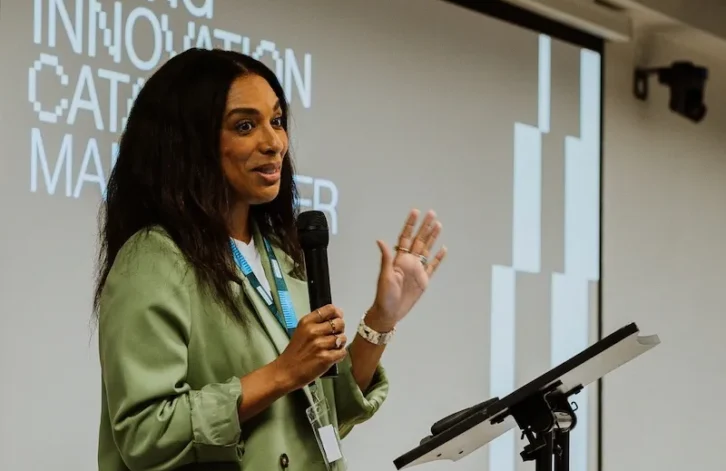
Liz Scott MBE, Director, Turing Innovation Catalyst Manchester
The UK ranks in the top five across global AI indexes for its AI capabilities. To remain a global leader in this age of AI, compute capacity must be abundant and readily available to translate the UK’s science and innovation credentials into measurable social benefits and economic growth.
Concerns about power capacity, water consumption and community impacts are becoming hard limits on data-centre expansion at the very moment that industries accelerate into AI. To ensure the UK continues to leverage the world’s most powerful AI tools, progress can’t be paused. That’s why Edge AI provides a crucial complementary path to propel IP-rich AI advancements to market, and it’s where Manchester is taking the lead.
Greater Manchester is once again taking a big swing on what it means to proactively build an AI ecosystem by launching a new Edge AI hub with a sharp focus on real-world deployment. If the UK follows suit with Manchester, where Edge AI is integrated within the wider innovation ecosystem, it will ensure that we’re using every available pathway to create immediate impact for national AI adoption.
Breaking the compute bottleneck
When we strategise AI growth, attention is poured into IP protection, talent, research excellence and algorithm curation, but without compute infrastructure, innovation halts and companies move their workloads outside of the UK.
To mitigate this, the UK government has set out a clear mandate for how it intends to drive the advancement of AI technology. This includes the introduction of regional AI Growth Zones, designed to balance out the benefits of innovation to support compute-intensive workloads.
We’ve already seen the first five AI Growth Zones announced at Culham in Oxfordshire, Spans Blyth and Cobalt Park in the North East, the former Ford Bridgend Engine site in South Wales, Prosperity Parc and Trawsfynydd in North Wales and North Lanarkshire in Scotland.
The purpose of these selected locations is to alleviate grid constraints that drive complex planning requirements and extended build timelines, because currently, 82% of data centre site builds experience delays.
Hyperscale data centres matter, but in Manchester we’re making sure they’re only one part of the AI picture, with Edge AI driving growth where it actually happens. Edge AI is the running of machine learning and artificial intelligence on devices, rather than relying entirely on external cloud servers – often streamlining processes and eliminating delays from long round-trip latency.
Think about clinical devices that can locally process sensitive diagnostic data or advanced manufacturing equipment using real-time computer vision for automated zero-defect quality inspection on high-speed assembly lines.
Edge AI keeps innovation moving for industries requiring both data security and operational intelligence. Decisions can be made where the data is created, and sovereignty concerns are lessened.
Manchester’s AI advantage
Manchester has already been acting as the UK’s real-world testbed for regional AI growth, with local companies collectively securing a valuation of $4.7bn. The city region has ranked 13th in Europe for AI talent because it delivers over 13,500 jobs, industrial innovation and skills development.
This hasn’t been by chance; it’s been a strategic collaboration between the region’s academic institutions, entrepreneurial momentum, and the private and public sectors to quickly scale the ecosystem.
Named the UK’s most AI-ready city for the third year in a row, Manchester has earned serious AI leadership credentials, not by trying to replicate what’s happening in London and the South East but by building an innovation engine that keeps AI companies at every level of maturity growing.
Manchester’s devolved status sets the expectation for how the entire region plays an active role in AI growth. With greater autonomy of funding, the public, private and academic sectors have worked in alignment to ensure the benefits of innovation can be reinvested into the next emerging founders.
Analysis of AI activity in Manchester defines this as the ‘flywheel effect’, an approach rooted in a distinctly Mancunian mindset of doing things differently.
Where Manchester is putting Edge AI to work
In this next phase of ecosystem growth, Manchester is accelerating Edge AI development by turning its devolved powers and innovation strengths into a city-region testbed.
Through programmes funded by the Local Innovation Partnership Fund, which recently brought £50m of funding to the city region, the entire region’s strengths are connected in a shared ecosystem that can act as a sandbox for real-world experimentation with Edge AI.
This lets teams prototype Edge AI solutions directly in the places they’re needed – healthcare settings, factories, neighbourhoods and labs – rather than waiting for national infrastructure or cloud-dependent pathways.
Manchester has shown what’s possible time and again. And while there isn’t a single blueprint for leveraging AI innovation to power growth, I firmly believe that the right combination of doubling down on local strengths, paired with ambitious horizon scanning, is producing results in the city’s ecosystem.
And I look forward to seeing how other regions can leverage this pathway to create UK-wide pockets of partnership-driven, place-relevant cluster-based growth that isn’t solely dependent on data-centre expansion.